Perler vs Hama vs Artkal: Which Fuse Beads to Choose
The Perler vs Hama debate has a short answer and a long one. The short answer: at the standard 5 mm Midi size all three brands interchange, so the "which fuse beads" question is really about color range, price, and how firmly each fuses. This is the long answer.
Perler vs Hama vs Artkal at a glance
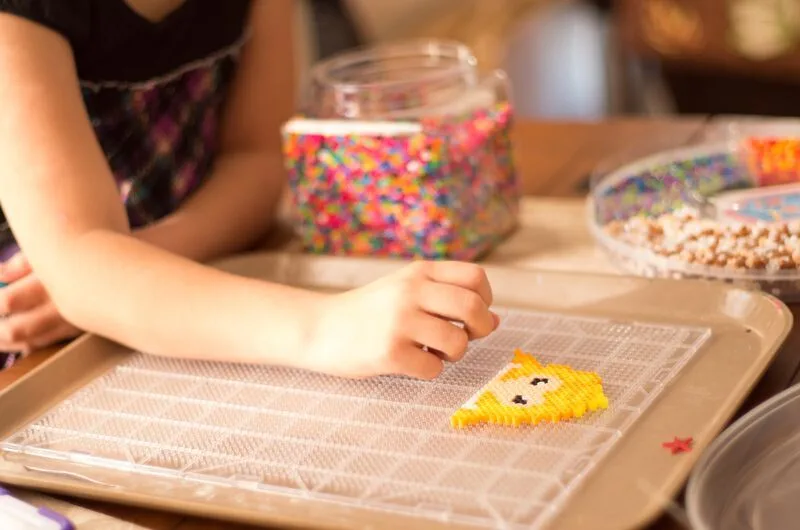
Fuse beads are small plastic tubes you stand on a pegboard, one bead per peg, then fuse together with a household iron and a sheet of parchment. The craft goes by many names — fuse beads, melty beads, iron beads — and the three brands below dominate it worldwide. Here is how they line up on the specs a buyer actually cares about.
| Brand | Sizes (mm) | Cross-brand fit | Origin | Price tier | Colors |
|---|---|---|---|---|---|
| Perler | Midi 5, Mini 2.6, Biggie 8 | Midi mixes with Hama & Artkal | USA | Mid, widely stocked | ~80–90 |
| Hama | Midi 5, Mini 2.5, Maxi 10 | Midi mixes; Mini runs 0.1 mm smaller | Denmark (EU) | Premium (imported in US) | Midi ~90, Mini ~59 |
| Artkal | S/R 5, C/A 2.6, T 8 | Hard S & C mix; soft A & R stay separate | China | Best value in bulk | S-5mm ~200 |
Read that table and the pattern is clear: the brands converge on hardware (a 5 mm bead on a shared pegboard) and diverge on catalog. Perler wins on availability, Hama on build quality, Artkal on color count and price. The rest of this article unpacks each of those, plus the compatibility rules that trip people up.
Are Hama and Perler the same bead?
People ask whether Hama and Perler beads are the same because patterns are shared across both without conversion. Functionally, at Midi size, they are: both are 5 mm hollow plastic cylinders that sit on the same grid and fuse at similar temperatures. A pattern charted for Perler works bead-for-bead in Hama Midi and the reverse.
They are not the same product, though. Perler is made in the United States and is the default brand in North American craft stores. Hama is made in Denmark by Malte Haaning Plastic, which produced the first Hama bead in 1971, and it dominates in Europe. The beads carry different color systems — Hama uses H-codes like H01 and H27, Perler uses color names — and, as covered below, they do not fuse identically even though they fuse together.
So "are Hama and Perler beads the same" is a yes on geometry and a no on brand, palette, and feel. If a pattern says "Perler" and you own Hama, build it anyway; just translate the colors by eye rather than hunting for a code match.
Can you mix the brands? Midi and mini compatibility
The convenient part of fuse-bead work: at Midi size the major brands interchange. Perler, Hama Midi, and Artkal S are all 5 mm, fit the same pegboards, and fuse in the same ballpark, so mixing them in one design is normal. Builders routinely drop an Artkal bead into a mostly-Perler piece to hit a color the Perler range does not carry — the whole point of the Artkal vs Perler comparison for most people is reaching that extra color.
Mini size is where you have to pay attention. The minis are not all the same diameter (see our full Perler bead sizes guide for every size in mm):
- Hama Mini is 2.5 mm. Perler Mini and Artkal's hard C series are 2.6 mm. That 0.1 mm sounds trivial but it accumulates across a row, so a Hama Mini bead can sit loose on a 2.6 mm board and an Artkal bead can crowd a Hama board.
- Artkal splits hard and soft. Per Artkal's own guidance, the hard S-5mm Midi and hard C-2.6mm Mini are made to be compatible with Perler and Hama. The soft A-2.6mm Mini and soft R-5mm Midi are EVA beads meant to be used on their own so they keep their flexible finish.
- The safe rule: stay within one bead size per project, and for minis specifically, avoid mixing Hama Mini with Artkal — pick one and commit the whole piece to it.
None of this changes how you read a chart. A 50-by-50 pattern is 50 beads square whether you build it in Midi or Mini; only the finished panel's physical size changes. This is also why fuse beads are the friendliest place to start converting images: the grid is a true square lattice with no row offset, so one chart cell equals one peg. Seed-bead stitches are messier — a size 11/0 Miyuki Delica is wider than it is tall (about 1.6 mm by 1.3 mm), so a square image charted bead-for-bead comes out roughly 20% wider than tall unless you add rows. Fuse beads sidestep that entirely. If you want to see how a photo becomes that grid, our photo-to-Perler walkthrough covers the image prep.
Which brand fuses best, and most evenly
Interchangeable does not mean identical on the iron. This is where beaders develop brand loyalty, and the consensus across long-running fuse-bead communities is fairly stable.
- Hama is the one most builders reach for when they want an even, durable melt. The beads are firm, hold their ring hole cleanly when fused, and resist warping. It fuses at a moderate temperature and is forgiving of a slightly long press, which is why finished Hama panels tend to look crisp and last.
- Perler melts the softest and fastest. That makes it the friendliest brand for kids and first projects — beads bond quickly with light pressure — but it also means the window between "fused" and "over-melted into solid dots" is narrower. Watch it closely and lift the parchment early.
- Artkal beads run a touch denser and slightly harder, with very clean holes, and many builders find they hold shape and color well. The hard S and C series fuse predictably alongside Perler and Hama; give them a couple extra seconds under the iron if they lag.
The technique is the same for all three: dry iron on medium-high with steam off, cover the design with parchment, press in slow circles for roughly 10 to 30 seconds until the bead tops fuse but still show their holes, then let the panel cool flat under a book so it does not curl. Because melt behavior differs by brand and by iron, run a 15-second test on a corner before committing a finished piece.
Color range and price: where each brand wins
Color range is the single biggest practical difference, and it is where Artkal pulls decisively ahead. Its flagship S-5mm Midi series carries around 200 official colors — roughly double what Perler or Hama offer — spanning fine gradients, transparents, metallics, and glow finishes. For flat sprite work eight to sixteen colors is plenty, but for photo conversion and portraits, more shades mean smoother skin tones and fewer visible bands.
Perler and Hama sit in a similar range: Perler markets on the order of 80 to 90 colors, and Hama's Midi line lists roughly 90 including its luminous and striped specials, with about 59 in the Mini range. Both cover every common need; you only feel the ceiling on gradient-heavy images.
On price and availability the order flips by region:
- Perler is the cheapest to buy casually in the US because it is everywhere — craft chains, big-box stores, online. You rarely pay shipping or wait.
- Hama is the premium option outside Europe. The build quality is worth it to many, but as an import it usually costs more per bead in North America.
- Artkal wins on value once you buy in volume. Bulk boxes — a single set can hold tens of thousands of beads across 200-plus colors — bring the per-bead cost well below the others, which is why photo-realistic builders standardize on it.
Which fuse bead brand should you buy?
There is no universal best fuse beads brand; there is a best one for your project and location. Match the brand to what you are actually making:
- Just starting, or buying for kids? Perler. It is the easiest to find, the cheapest to try, and the most forgiving on the iron.
- Want the most durable, cleanest finished pieces? Hama, if you can get it at a fair price. Its even melt shows in the final panel.
- Converting photos or detailed pixel art? Artkal. The ~200-color S-5mm palette and bulk pricing are built for exactly that, and the hard series still mixes with a Perler or Hama bead when you need one specific shade.
Most builders end up with a main brand plus a supplementary box of Artkal for color reach — the same way seed-bead artists keep one primary catalog and pull accents from another, a habit we cover in the seed-bead brand comparison. Buy one brand's starter set, learn how it fuses, and expand from there.
Common questions
Are Hama and Perler beads the same?
Same craft and, at Midi size, the same 5 mm footprint — but different companies (Perler is US, Hama is Danish), different color codes, and slightly different melt behavior. Midi beads from both share pegboards and fuse together.
Can you mix Hama and Perler beads?
Yes at Midi 5 mm. Be careful with minis: Hama Mini is 2.5 mm versus 2.6 mm for Perler Mini and Artkal C, and Artkal's soft A and R series should be used on their own.
What size are Perler, Hama, and Artkal beads?
Midi 5 mm is the default across all three. Minis are 2.5 mm (Hama) or 2.6 mm (Perler, Artkal C/A), and each brand also sells a larger toddler size (Perler Biggie 8 mm, Hama Maxi 10 mm, Artkal T 8 mm).
How Beadify helps
Once you have picked a brand, the slow part is turning your image into a chart with the right colors. Beadify converts a photo, logo, or sprite into a clean square-grid pegboard chart and matches every color against the real Perler, Hama, and Artkal catalogs, then bakes the exact brand color codes into the exported PDF. Because the catalogs are separate, you can design a pattern once and switch between the Perler, Hama, and Artkal palettes to see the same piece rendered in each brand's actual colors before you buy a single bead.
That is the whole workflow: upload, pick the loom (square) grid so one cell equals one peg, cap the palette to the colors you own, and export a numbered chart with per-color counts. The free plan handles the conversion; the brand color-code matching and multi-catalog switching come with a free 7-day Pro trial, no card to start. If you want the step-by-step, our free Perler bead pattern maker guide walks the exact settings, and what to look for in bead pattern software covers why brand color matching matters at all.
Related reading
To go deeper on converting images into fuse-bead charts, these three pair well with this comparison:
- Free Perler Bead Pattern Maker: Image to Pegboard Chart covers grid size, pegboard sizing, and ironing.
- How to Turn a Photo into a Perler Bead Pattern handles the image-prep choices that make or break a portrait.
- Pixel Art to Perler Pattern: Keep Every Pixel maps one sprite pixel to one bead with no mushy resampling.
Pick the brand your project and region point you to — Perler to start, Hama for durability, Artkal for color and value — and remember they mostly interchange at 5 mm, so the choice is rarely permanent. Chart the design, sort your colors, and the building is the easy part.
Turn a photo into a fuse-bead chart matched to real Perler, Hama, and Artkal color codes — free to start.
Try Beadify free →